






Aviation Maintenance Technology Program
Our RN to BSN program is a Bachelors degree completion option for Registered Nurses.
Why Choose an Aviation Maintenance Technology Program at SJVC?
The Aviation Maintenance Technology program is one of SJVC’s Trades and Industrial programs, designed to help students build technical knowledge and hands-on skills used in aircraft maintenance. As an aviation mechanic school, the program is approved by the Federal Aviation Administration (FAA), meaning the curriculum meets established industry standards for training aviation maintenance technicians. (2)
Students learn in an environment that reflects real-world aviation settings, developing experience in inspecting, servicing, and repairing aircraft systems. Coursework is designed to align with the knowledge areas recommended for aviation maintenance, including airframe and powerplant systems. (1)
With a focus on practical application and structured training, students can build skills used in aviation environments while working toward meeting aircraft technician requirements and certification pathways.

REAL-WORLD SKILLS

CHOOSE YOUR PATH

FLEXIBLE LEARNING OPTIONS

AFFORDABLE TUITION
Program Details
WHAT WILL I LEARN?
The SJVC Aviation Maintenance Technology program focuses on building the technical knowledge and hands-on skills used to inspect, maintain, and repair aircraft systems. Training is aligned with Federal Aviation Administration (FAA) standards. (1) (2)
Students develop skills in areas such as:
- Engine Systems: Reciprocating and turbine engine overhaul and maintenance
- Structural Repair: Working with metallic and non-metallic airframe structures
- Systems & Instrumentation: Electrical, hydraulic, and pneumatic systems
- Safety & Compliance: Fire protection, lubrication, and fuel systems
- Documentation: Interpreting maintenance manuals and FAA-required record-keeping (1)
Through a combination of classroom instruction and applied learning, students practice working with aircraft components and systems while developing skills used in aircraft mechanic roles.
Graduates of the Aviation Maintenance Technology program may be eligible to test for the Airframe and Powerplant (A&P) certification through the Federal Aviation Administration (FAA). (1) Completion of the program does not guarantee certification or licensure.
For a closer look at training and career pathways, visit our Aviation Maintenance Career Guide.
Application Process
Military Policy
COST & FINANCIAL AID
Education is the most important investment you can make in your future. There is a financial plan available for everyone, including a broad range of financial assistance options. Visit SJVC’s Net Price Calculator to get personalized information on college costs and financial aid. Check out SJVC’s Academic Catalog to learn about program costs by campus and credential level. You also can talk to an Admissions Advisor to discuss the costs of your chosen program and schedule an appointment with an experienced financial aid officer. Student loans, grants, and scholarships are available to those who qualify.
PROGRAM AVAILABILITY
SJVC’s Aviation Maintenance Technology program is conveniently located at the Fresno – Trades Education Center (TEC) location.
ACCREDITATION & APPROVALS
The Aviation Maintenance Technology program is approved by the Federal Aviation Administration.
Flight Standards District Office
1781 E. Fir Avenue, Ste. 203
Fresno, CA 93720
(559) 297-2150
www.faa.gov
Institutional Accreditation
San Joaquin Valley College is accredited by the WASC Senior College and University Commission (WSCUC), 1080 Marina Village Parkway, Suite 500, Alameda, CA 94501, Phone: 510-748-9001, Fax: 510-748-9797.
The WSCUC is an institutional accrediting body recognized by the Council for Higher Education Accreditation and the U.S. Department of Education.
State Approvals
CALIFORNIA
SJVC is a private institution and is approved to operate as an accredited institution by the California Bureau of Private Postsecondary Education (BPPE). Approval to operate means that SJVC has been found in compliance with the standards set forth in the California Private Postsecondary Education Act of 2009 (as amended) and Title 5, Division 7.5, – Private Postsecondary Education of the California Code of Regulations. As a prospective student, you are encouraged to review this catalog prior to signing an enrollment agreement. You are also encouraged to review the School Performance Fact Sheet, which must be provided to you prior to signing an enrollment agreement.
A student or any member of the public may file a complaint about this institution with the Bureau for Private Postsecondary Education by calling (888) 370-7589 or by completing a complaint form, which can be obtained on the Bureau’s internet website (www.bppe.ca.gov).
CONTINUING EDUCATION FOR GRADUATES
What Will I Learn?


Find your path in Aviation Maintenance Technology
Discover What It’s Like to Become an Aviation Maintenance Technology Student
Career Opportunities
Aircraft mechanics (also called Aviation Maintenance Technicians or AMTs) are responsible for the airworthiness of an aircraft. Their day-to-day includes diagnosing mechanical or electrical issues, repairing wings and brakes, and replacing defective components using precision tools. (3)
Aircraft mechanics may also be called aircraft maintenance technicians and aircraft technicians. An aircraft maintenance tech tests aircraft parts and reviews manuals to identify the best procedures for repair. Once maintenance is complete, they test the work and the parts to make sure they are functioning correctly. Aircraft mechanics are responsible for keeping detailed records of the maintenance performed on an aircraft. (3) (4)
Successful Grads
Ask one of our 88,000+ graduates about their SJVC experience and they’ll likely describe it as life-changing.
Hands-On Technical Labs & Practical Training
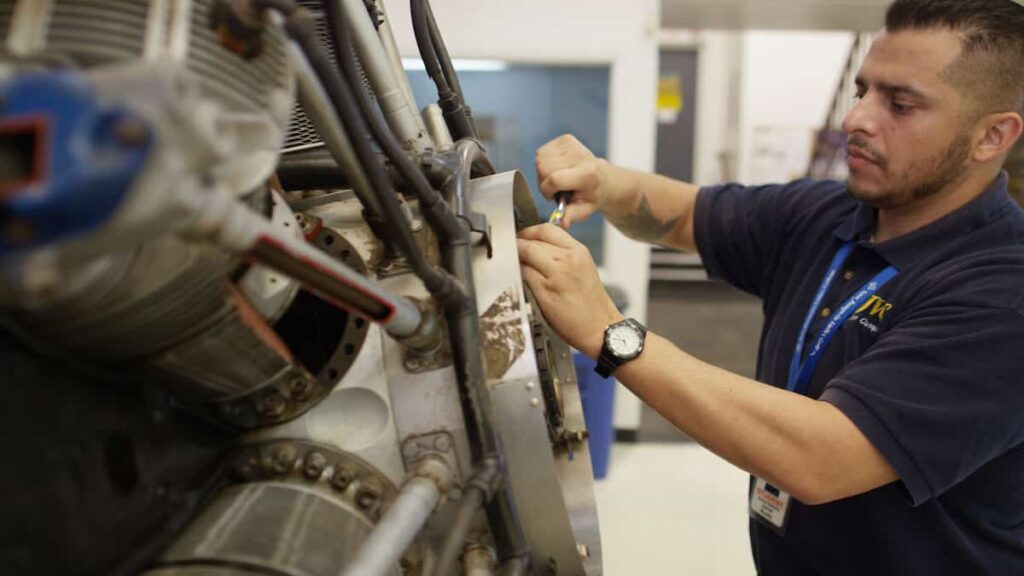
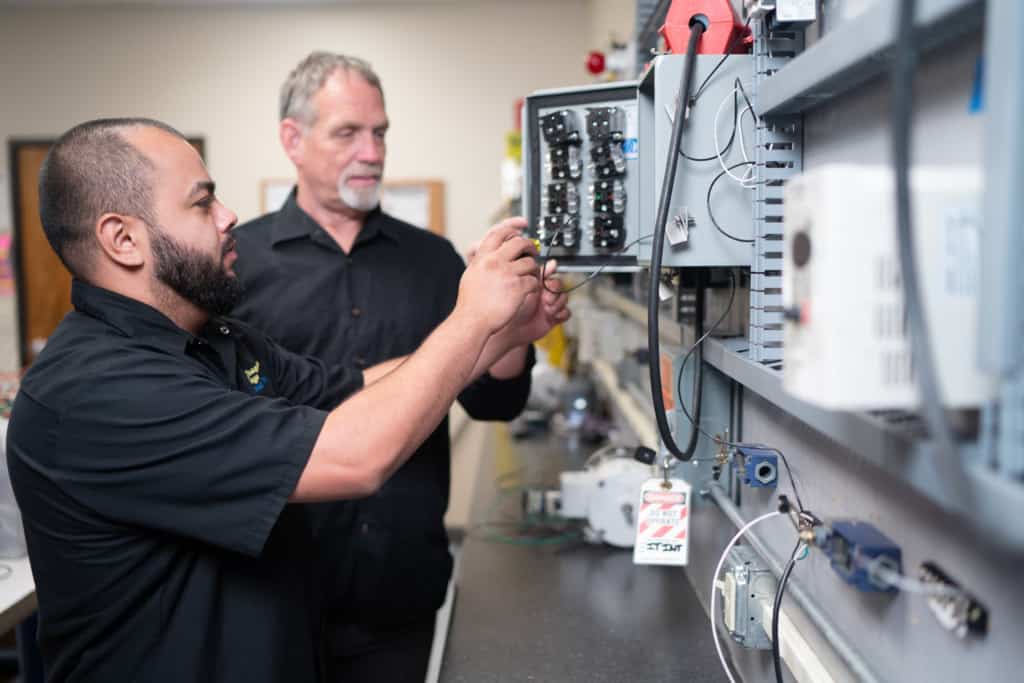
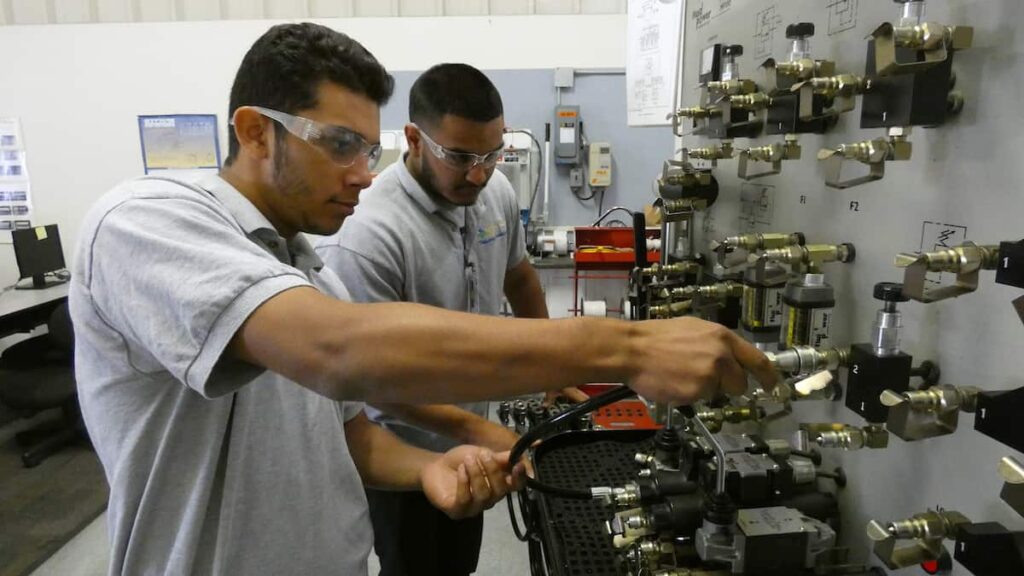
Aviation maintenance is a hands-on field, and this aircraft mechanic trade school emphasizes applied learning throughout training. Students develop practical experience by working with tools, equipment, and aircraft systems in lab-based environments designed to reflect real-world aviation settings.
Training includes opportunities to service, inspect, repair, and troubleshoot aircraft engines and airframe structures while building familiarity with industry procedures and safety standards.
Aviation Maintenance Technology Program FAQs:
-
Students in an aircraft maintenance technology program develop knowledge across a range of aircraft systems used in maintenance and repair. Training typically includes airframe and powerplant components, such as engine systems, electrical systems, and structural elements of the aircraft.
Students may also gain experience working with systems related to fuel, hydraulics, pneumatics, and basic avionics, along with inspection and troubleshooting procedures used in aviation maintenance. Training is designed to reflect the types of systems aviation maintenance technicians work with in real-world environments.
-
Yes. SJVC’s Aviation Maintenance Technology program is approved by the Federal Aviation Administration (FAA), meaning the curriculum meets established standards for aviation maintenance training. (1) (2)
FAA-approved programs are designed to cover the knowledge and skill areas associated with airframe and powerplant maintenance. Graduates may be eligible to pursue FAA certification pathways, such as the Airframe and Powerplant (A&P) certification. (1) Completion of the program does not guarantee certification or licensure.
-
Admission requirements for the Aviation Maintenance Technology program are designed to help ensure students are prepared for training and industry expectations.
Applicants typically must: (1)
- Provide a valid, unexpired driver’s license
- Have no DUI convictions within the past 3 years
- Be at least 18 years of age by the end of their first 16 weeks in the program
Additional requirements may apply. For full admissions details and next steps, visit the College Catalog.
-
Aircraft mechanics, also known as aviation maintenance technicians, inspect, maintain, and repair aircraft systems to help support safe operation. Their work can include diagnosing mechanical or electrical issues, performing routine maintenance, and replacing or repairing components. They also follow technical manuals, test systems and parts after maintenance, and keep detailed records of the work performed. (3)
For a closer look at day-to-day responsibilities and career paths, explore the Aviation Maintenance Career Guide.
-
The length of an aircraft mechanic program can vary, but training programs like SJVC’s can be completed in as few as 14 months for a certificate of completion. (1)
-
Learning how to become an airline mechanic typically involves completing an FAA-approved aviation maintenance technology program, gaining hands-on experience, and meeting certification requirements such as the FAA Airframe and Powerplant (A&P) certification. (2)
- San Joaquin Valley College. “College Catalog & Program Information.” https://www.sjvc.edu/admissions/catalog/
- Federal Aviation Administration (FAA). “Become an Aviation Maintenance Technician.”
https://www.faa.gov/mechanics/become - U.S. Bureau of Labor Statistics. “Aircraft and Avionics Equipment Mechanics and Technicians.”
https://www.bls.gov/ooh/installation-maintenance-and-repair/aircraft-and-avionics-equipment-mechanics-and-technicians.htm - O*NET OnLine. https://www.onetonline.org/link/summary/49-3011.00