
Electrical Technology Program
Prepare for a hands-on career working with electrical systems through SJVC’s Electrical Technology program. Build skills in installation, maintenance, and troubleshooting. Upon completion, graduates may be eligible to pursue applicable certification or licensure exams based on state-specific requirements.
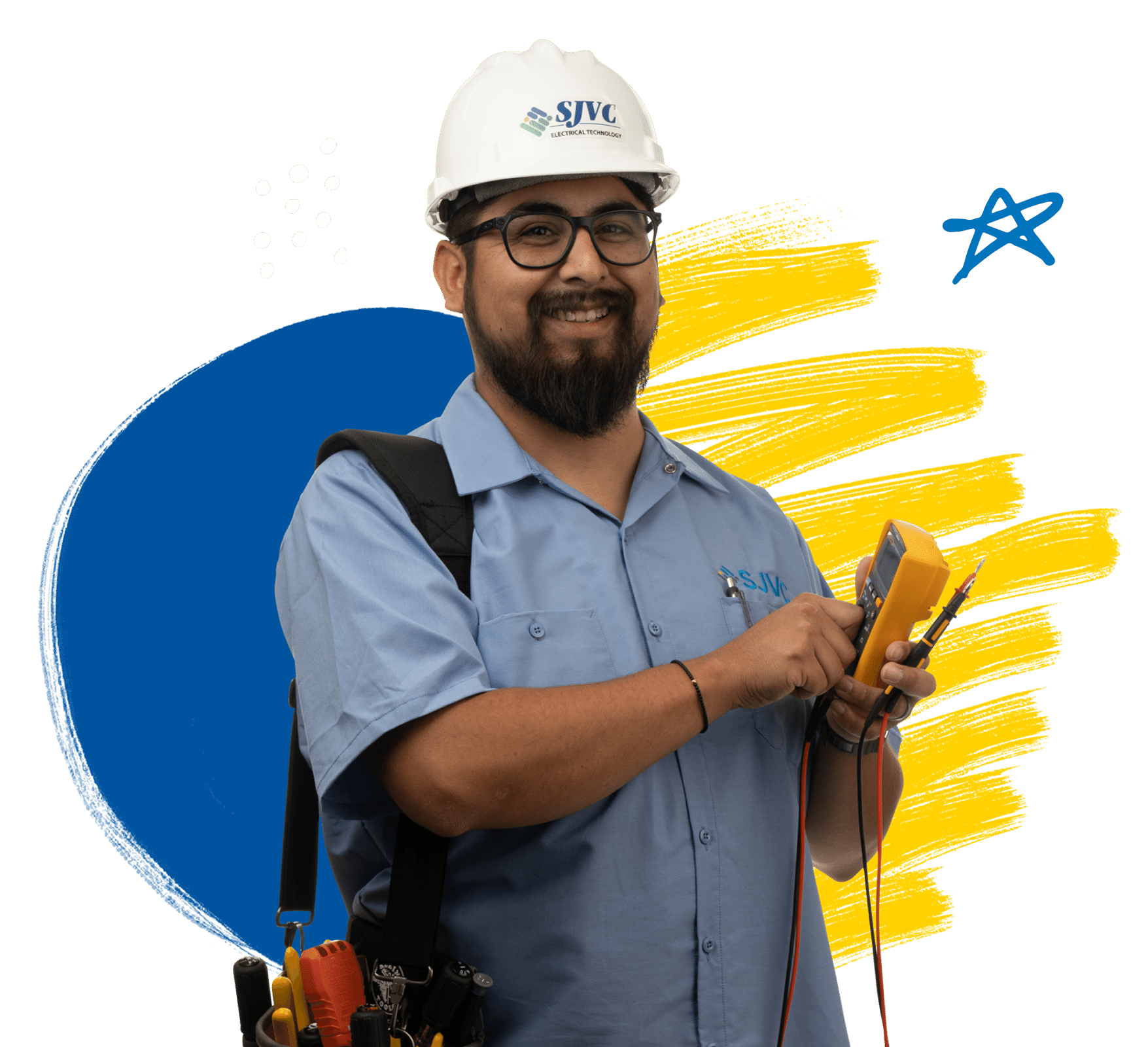
Why Choose SJVC for Electrical Training
The Electrical Technology program is part of SJVC’s Trades and Industrial Programs and is designed to help students build practical skills in installing, maintaining, and troubleshooting electrical systems. Training in the SJVC electrician program focuses on real-world applications, giving students experience with the tools and components used by residential and industrial electricians. (1)
Students learn in a structured, hands-on environment that reinforces safety practices and industry-relevant knowledge. This applied approach supports those exploring electrician training programs and working with electrical systems across residential, commercial, or industrial settings.

REAL-WORLD SKILLS

START YOUR PATH

FLEXIBLE LEARNING OPTIONS

AFFORDABLE TUITION
Program Details
WHAT WILL I LEARN?
Electrical technology is the study of the systems, circuitry, and installation standards that power our modern world. SJVC’s electrical technical training is designed to help students build skills used to work with electrical systems.
Students may learn:
- Residential and commercial wiring and electrical installations
- Electrical conduit bending and raceway systems
- Troubleshooting and diagnostic techniques for electrical systems
- Electrical theory, circuits, and technical math
- Blueprint reading and electrical planning
- Safety practices and National Electrical Code (NEC) standards
- Industrial systems, including programmable logic controllers (PLCs)
Through a combination of classroom instruction and applied learning, students practice installing, maintaining, and troubleshooting electrical systems while building familiarity with tools, materials, and industry procedures used in an electrical technician certificate pathway. Students may also have the opportunity to earn industry-recognized certifications such as OSHA 10-Hour Construction and CPR. (1)
Program availability and educational pathways may vary by campus and state. Students may have the option to pursue a Certificate of Completion or, at select locations in California and Arizona, an Associate of Science degree in Electrical Technology. (1)
Application Process
Military Policy
COST & FINANCIAL AID
Education is the most important investment you can make in your future. There is a financial plan available for everyone, including a broad range of financial assistance options. Visit SJVC’s Net Price Calculator to get personalized information on college costs and financial aid. Check out SJVC’s Academic Catalog to learn about the cost of the Electrical Technology program by campus and credential level. You also can talk to an Enrollment Services Associate to discuss the costs of your chosen Electrical Technology program and schedule an appointment with an experienced financial aid officer. Student loans, grants, and scholarships are available to those who qualify.
PROGRAM AVAILABILITY
SJVC’s Electrical Technology program is available at the following campuses:
ACCREDITATION & APPROVALS
The Electrical Technology program at the Bakersfield, Fresno Trades Education Center (TEC), Modesto (Salida), Ontario, Rancho Mirage, Sacramento, San Leandro, Temecula, Victor Valley (Hesperia), and Visalia campuses is approved by the Department of Industrial Relations, Division of Labor Standards Enforcement.
The Department of Industrial Relations, Division of Labor Standards Enforcement is located at 1515 Clay Street, Suite 1902, Oakland, CA 94612, 510 286 3900. www.dir.ca.gov/dlse/ecu/electricaltrade.html
Institutional Accreditation
San Joaquin Valley College is accredited by the WASC Senior College and University Commission (WSCUC), 1080 Marina Village Parkway, Suite 500, Alameda, CA 94501, Phone: 510-748-9001, Fax: 510-748-9797.
The WSCUC is an institutional accrediting body recognized by the Council for Higher Education Accreditation and the U.S. Department of Education.
State Approvals
ARIZONA
The Phoenix campus is licensed by the Arizona State Board for Private Postsecondary Education. Inquiries concerning the standards or school compliance may be directed to the Board at 1740 West Adams Street, #3008, Phoenix, AZ 85007, (602) 542-5709, website: https://ppse.az.gov
CALIFORNIA
SJVC is a private institution and is approved to operate as an accredited institution by the California Bureau of Private Postsecondary Education (BPPE). Approval to operate means that SJVC has been found in compliance with the standards set forth in the California Private Postsecondary Education Act of 2009 (as amended) and Title 5, Division 7.5, – Private Postsecondary Education of the California Code of Regulations. As a prospective student, you are encouraged to review this catalog prior to signing an enrollment agreement. You are also encouraged to review the School Performance Fact Sheet, which must be provided to you prior to signing an enrollment agreement.
A student or any member of the public may file a complaint about this institution with the Bureau for Private Postsecondary Education by calling 888-370-7589 or by completing a complaint form, which can be obtained on the Bureau’s internet website (www.bppe.ca.gov).
CONTINUING EDUCATION FOR GRADUATES
Trades Studies
Program Description
SJVC’s Trades Studies program may be completed in 25 weeks. The program is designed for trades professionals who want to advance their career and who have earned a certificate of completion in Electrical Technology; Heating, Ventilation, Air Conditioning, and Refrigeration; or Maintenance Technician from an institution of higher learning accredited by an agency that is recognized by the United States Department of Education. The Trades Studies Associate of Science degree affords excellent opportunities for professional growth and development through instruction in general education coursework designed to produce the competencies of higher education that employers expect of college graduates.
Electrical Technology Program Highlights




Learn More About Becoming an Electrical Technician
Discover What It’s Like to Be an Electrical Technology Student

Career Opportunities
Electricians install, maintain, and repair components of the systems that provide electrical power in buildings and other structures. (2) Those exploring how to become an electrician typically begin with structured training and then gain hands-on experience in the field. Electrical work also includes systems for communication, lighting, and control systems used in residential, commercial, and industrial environments. (2)
Electricians must understand and follow building codes based on the National Electrical Code and may work on construction sites installing wiring and equipment. (2)
Electricians who maintain equipment must identify and repair equipment that is not working correctly. They may have to fix or replace parts of electrical equipment, ranging from lighting fixtures to motors. (2)
To learn more about career paths, responsibilities, and what to expect in the field, explore SJVC’s Electrical Technology Career Guide.
Industry Standards & Safety Preparedness
SJVC’s Electrical Technology program emphasizes the industry standards and safety practices used by professionals working with electrical systems. Students develop an understanding of the National Electrical Code (NEC) and its application in electrical installations and maintenance.
Training also focuses on adhering to industry safety practices, including the National Electrical Code (NEC). Through this approach, students build foundational knowledge aligned with industry expectations and may be prepared to pursue certification or licensure opportunities based on state requirements. In California, graduates may be eligible to sit for the California General Electrician’s Certification Exam, while in Arizona, licensure requirements vary by role, and some advanced positions may require licensure. (3) (4)
Successful Grads
Ask one of our 88,000+ graduates about their SJVC experience and they’ll likely describe it as life-changing.
Electrical Technology Program FAQs
-
No prior electrical experience is typically required to enroll in the Electrical Technology program. Training is designed to introduce foundational concepts and skills, including electrical theory, wiring, and safety practices, while building toward more advanced applications.
Students develop knowledge through a combination of classroom instruction and hands-on learning, allowing them to gain experience with tools, equipment, and electrical systems used in the field.
-
Yes. SJVC’s Electrical Technology program includes hands-on training as a core part of the learning experience. Students practice working with tools, equipment, and electrical systems in lab-based settings designed to reflect real-world environments.
Training includes applied activities such as wiring, conduit bending, and troubleshooting, helping students build practical skills alongside foundational electrical knowledge.
-
The time it takes to become an electrician can vary based on training, certification requirements, and work experience. At SJVC, students can complete the Electrical Technology Certificate of Completion program in as few as 10 months. (1)
After training, individuals may choose to pursue certification or licensure, which can involve meeting state-specific requirements such as passing an exam or completing additional work experience. (2) Completion of the program does not guarantee certification or licensure.
See the Electrical Technology Career Guide for a closer look at the steps involved and what to expect in the field.
-
Requirements vary by state. In California, electricians working for a C-10 licensed contractor must generally be certified or registered as electrician trainees while gaining experience. In Arizona, licensure is generally not required for entry-level electrical work, though some advanced roles may require licensure. (3) (4)
-
SJVC’s Electrical Technology program focuses on building the foundational skills used in apprenticeship pathways. Students gain hands-on experience with wiring, electrical systems, safety practices, and troubleshooting. These are skills commonly applied in entry-level roles under the supervision of experienced electricians.
While requirements can vary by employer and program, completing training may support students as they pursue opportunities to gain supervised work experience in the electrical industry.
-
Admission requirements vary, but applicants are generally expected to meet SJVC’s institutional admissions criteria.
At SJVC, this may include:
- Providing a valid state-issued driver’s license
- Participating in an admissions interview
- Meeting minimum age requirements based on the state of attendance
- Providing proof of high school graduation or equivalent
- Completing an admissions assessment and achieving the required score
Admission requirements vary and are based on SJVC’s institutional criteria outlined in the College Catalog.
For full details and next steps, visit the Admissions page.
Want to Learn More?
Request Information
All fields using an asterik (*) are required.
Our RN to BSN program is a Bachelors degree completion option for Registered Nurses.
- San Joaquin Valley College. “College Catalog & Program Information (2026–2027)” https://www.sjvc.edu/admissions/catalog/
- U.S. Bureau of Labor Statistics. “Electricians.”
https://www.bls.gov/ooh/construction-and-extraction/electricians.html - California Department of Industrial Relations. “Electrician Certification Program.”
https://www.dir.ca.gov/dlse/ecu/electricaltrade.html - Arizona Registrar of Contractors. “License Classification Requirements.” https://roc.az.gov/license-classification-requirements