








 Employment outlook of heating, ventilation, air conditioning, and refrigeration technicians (HVAC-R) is positive, according to the U.S. Bureau of Labor Statistics. (1) Earning your HVAC certificate in California is an important step toward a potentially rewarding and fulfilling career. Here we’ll explain how to become an HVAC technician in California, what you’ll learn in an HVAC-R program, and how to prepare for an HVAC career.
What Does an HVAC Technician in California Do?
An HVAC technician repairs, installs, and maintains systems that heat and cool air as it moves through the system. They may work with furnaces, air conditioners, ductwork, thermostats, boilers, and ventilation systems. An HVAC-R technician performs similar tasks, but also works with refrigeration systems, such as those found in commercial refrigeration units and industrial cooling systems. (1)
California’s climate and industries create opportunities for HVAC and HVAC-R technicians, whether they’re installing a residential air conditioning system or maintaining warehouse refrigeration units.
How to Become an HVAC Technician in California
Step 1: Complete HVAC Technician Training
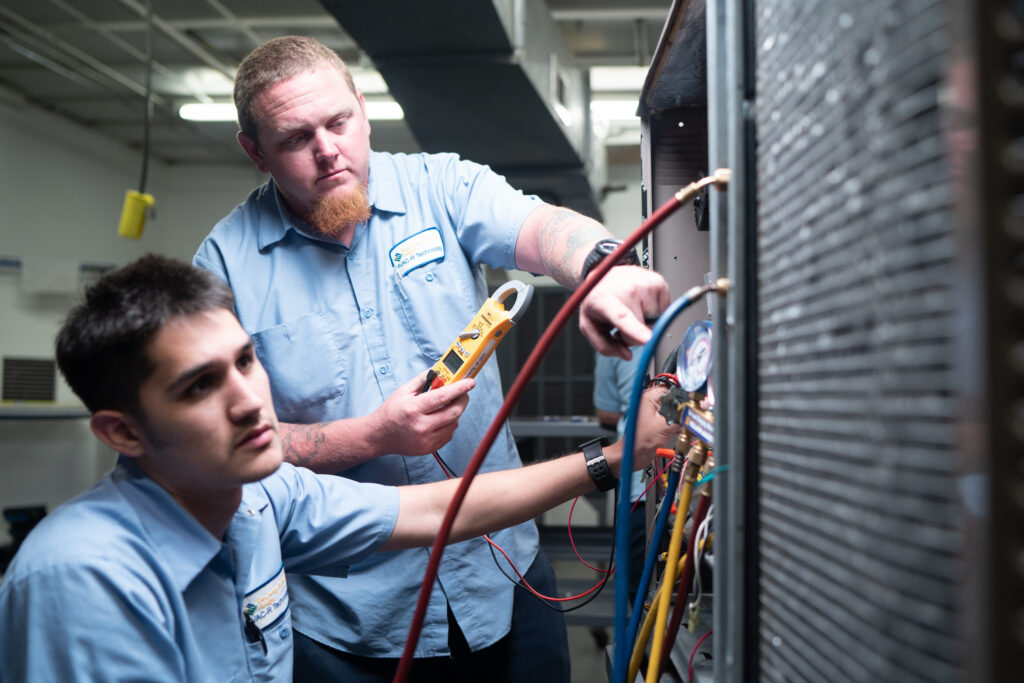
An HVAC-R program teaches the foundational skills, theory, and hands-on training for entry-level employment in the field. During your coursework, you’ll learn the basic principles of heating, cooling, and refrigeration systems, electrical theory, troubleshooting and diagnostic methods, and the safe handling of tools, equipment, and refrigerants. Look for a school that focuses on developing career-focused skills in hands-on environments.
Step 2: Earn EPA Section 608 Certification
An HVAC-R training program prepares students to sit the EPA Section 608 certification exam.* EPA Section 608 certification is a federally mandated requirement for anyone who maintains, installs, repairs, or disposes of equipment containing regulated refrigerants. (2)
Step 3: Gain Hands-On Experience
Gain real-world experience working with HVAC-R systems. Your training program should include opportunities for hands-on practice. Also, you should take advantage of your school’s Career & Student Services departments as well, where you can find resources to help with your job search upon graduation.
Step 4: Consider Additional Industry Certifications
As you progress in your career, you may wish to secure additional HVAC certifications to build your skillset and improve your employability, such as NATE or RSES certifications.
- NATE (North American Technician Excellence) is a voluntary program that offers specialty certifications in areas such as commercial refrigeration, gas furnaces, heat pumps, and more. NATE certifications are held in high regard by employers. (3)
- RSES (Refrigeration Service Engineers Society) offers certificates with a heavy focus on refrigeration, AC, and heating. RSES certifications are popular with HVAC-R technicians seeking specialized refrigeration credentials. (4)
- Manufacturer-specific certifications are useful for technicians who serve specific brand equipment, especially when under warranty.
Step 5: Understand California Contractor Licensing Requirements
California law requires HVAC technicians to possess their EPA Section 608 certification. Entry-level employees working for licensed contractors do not need individual contractor licenses, as the employer assumes all legal, financial, and safety responsibilities. (5) However, without your own license, you cannot contract or perform HVAC jobs on your own when the total cost of labor or materials exceeds $1,000. (6)
HVAC Certification and Licensing in California
EPA Section 608 Certification
EPA Section 608 certification is required for anyone who works with equipment containing regulated refrigerants. (2)
NATE Certification
NATE certification is seen as a mark of excellence by many employers, but is not required for HVAC technicians in the state of California. (3)
California C-20 Contractor License
If you plan to work as an independent contractor, you will eventually need a C-20 Contractor License, which qualifies you to work on HVAC-R systems where the total cost of labor and materials exceeds $1,000. A C-20 is also required to supervise unlicensed employees. To qualify for the exam, you must have at least 4 years of journeyman-level HVAC experience within the last 10 years. (5)
How Long Does It Take to Become an HVAC Technician in California?
How long it takes to become a California HVAC technician depends on the training path you take. An HVAC-R apprenticeship can take 4 to 5 years of on-the-job training and yearly classroom instruction. (7) In contrast, an HVAC-R training program that prepares you for entry-level employment in the industry can take as few as 10 months to complete.
HVAC-R Technician Jobs
The outlook for HVAC-R technicians appears positive. The Bureau of Labor Statistics expects commercial and residential building construction to drive employment growth. Additionally, a growing number of sophisticated climate-control systems may increase demand for qualified heating, air conditioning, and refrigeration mechanics and installers (HVAC technicians). (1)
Start Preparing for an HVAC Career
Ready to start working towards an HVAC career? Check out SJVC’s Heating, Ventilation, Air Conditioning & Refrigeration (HVAC-R) program.
*SJVC does not guarantee students will successfully pass these exams or be certified or licensed as a result of completing the program.
Resources
- Bureau of Labor Statistics, U.S. Department of Labor, Occupational Outlook Handbook, Heating, Air Conditioning, and Refrigeration Mechanics and Installers, https://www.bls.gov/ooh/installation-maintenance-and-repair/heating-air-conditioning-and-refrigeration-mechanics-and-installers.htm (visited August 02, 2026)
- U.S. Environmental Protection Agency. (n.d.). Section 608 technician certification requirements. Retrieved July 28, 2026, from https://www.epa.gov/section608/section-608-technician-certification-requirements
- North American Technician Excellence. (n.d.). Home. Retrieved July 28, 2026, from https://natex.org/
- Refrigeration Service Engineers Society. (n.d.). Home. Retrieved July 28, 2026, from https://rses.org/
- California Contractors State License Board. (n.d.). C-20 – Warm-air heating, ventilating and air-conditioning contractor. https://www.cslb.ca.gov/About_Us/Library/Licensing_Classifications/Licensing_Classifications_Detail.aspx?Class=C20
- California Contractors State License Board. (2024, December 30). Handyperson exemption to increase to $1,000 in 2025 [Press release]. https://www.cslb.ca.gov/Resources/PressReleases/2024/AB2622.FINAL.pdf
- California Department of Industrial Relations, Division of Apprenticeship Standards. (n.d.). Air conditioning & refrigeration apprenticeship. https://www.calapprenticeship.org/programs/air_conditioning_apprenticeship.php